Showing posts with label Libby Koponen. Show all posts

Your image of the week?

Linda Wingerter brought these beautiful eggs she'd made (photograph by Alvina) to an Easter party.

Eggs have been used to celebrate birth and spring for thousands of years in many cultures -- in ancient Egypt they dyed them and children rolled them (some people think this is where Dolly Madison got the idea for the White House Easter Egg party); in China red eggs celebrate a baby's first month of life.

This past week, some children in town made these string eggs and their mother shared them with me:


They also made these, using onion skins to make the patterns and dye the eggs:


So, I choose these eggs as my image (or images) of the week. I think they say better than words can my hopes for this spring, and new starts. What are your images of the week?

Books that hold up and books that don't


Some friends and I were talking about re-reading books we had loved as children, and how some hold up and some don't. For me, LITTLE WOMEN really held up -- but someone else found all the mother's lectures and Louisa May Alcott's own preachiness really annoying. I did, too, but I still love the book anyhow and suspect that as a child, I ignored those parts the way I ignored much of what the adults in my life said.

Some books that did hold up for me:
The Secret Garden -- I may even love this MORE now, even though I never could get as interested in Colin as I was in Mary, AND liked her better before she became nice
The Hobbit -- especially the scene with the trolls,and when they are first riding into Rivendell
very old MADs, from the late 1950s and early 1960s--they still make me laugh out loud
fairy tales
nursery rhymes
the d'Aulaires Abraham Lincoln
--to name a random few. I could go on and on, but what's going to be most interesting about this post is what other people think.

I also reread a Giant Golden book called ASTRONOMY and could see why I liked it so much, but as an adult, I didn't read every word. Maybe as a kid I didn't either! I was sad, though, to see something I don't know if I noticed as a child: that the scientists and astronauts were always men of European ancestry -- and that even the children doing simple experiments were white boys. People -- men and women -- with dark skins appeared in skin-tight outfits stretching their arms to the moon. Once a woman in a neat suit, hat, and gloves looked at a meteorite with her children. The text talked about MEN going into space someday.

If I get impatient with PC things, I will remember this book and its not-so-subtle message. I hope I ignored it the way I ignored the preachiness in LITTLE WOMEN but I wonder....

What didn't hold up:

Alice in Wonderland -- this wasn't one of my FAVORITE books as a kid, but I did like it a lot. I thought Alice was really smart and both loved and admired the way she always tried to figure everything out. When I reread it as an adult, I realized with dismay that that was supposed to be funny! I also found the book too boring to finish.

Then there were some classics that I could never get into as a child and can't now--like Carl Sandburg's short stories for kids. One was in a beloved, literally loved-to-pieces anthology illustrated by Garth Williams called THE TALL BOOK OF MAKE BELIEVE (this story was NOT by Carl Sandburg -- it's "The Very Mischief"):
Although I read everything else in that book over and over and over, I could never finish the Carl Sandburg story. It just seemed pointless and kind of stupid -- the kind of silliness some adults think children like. I also hated (and still hate) Aesop's Fables.

What about you? What has held up? What hasn't?

I'm especially curious about all the great children's books I've read for the first time as an adult, because I just don't know what I would have thought of them as a child.

(I am only listing authors who are dead in keeping with our blog's unofficial policy of not discussing work by living authors....not that we have ever even really talked about this, we just don't seem to do it.)

When is it time to give up on a ms.?


An agent told me recently that when she looks over her list, the mss. that ended up selling the best are the ones that took longest to place. What's the most number of times you or your agent have sent something out before it sold or you gave up on it?I love those stories of mss. that got rejected over and over, and then went on to become famous books -- here's a list of 14 books that became famous that were rejected over and over by publishers. Some I'd heard of, some I hadn't.....but I find it encouraging, especially the comments that must have seemed idiotic to the authors, like:
"Does anyone drown? [to the author of KON TIKI] Then it can't be very interesting."

But sometimes when a ms. doesn't sell, maybe it SHOULDN'T. Dear Genius has lots of stories about mss. that didn't quite work -- by people who then went on to write other things that worked brilliantly. For example:

"....I don't mean to sound cross, but I felt so hopeful when you left my place last weekend, and was a little depressed by the ms. when I read it (several times) this week...I wish I could be more constructive but until you do more on this it is pretty hard for me to be. I will say this: I think your first "chapter" can't be called "The Tiger," and you can't just say in two lines that this Frances was in bed and she couldn't sleep...."

Yes, it was the first Frances book -- published many rewrites later as Bedtime for Frances.


There is really no way for an author to know how it will turn out or which (worth working on or not) is true of a particular ms....what I have concluded about my own work is that it just depends on how interested I am in the story and TIME usually clarifies that. If, years after I first wrote something, I reread it, see the flaws, and want to fix them, I do. If I read it over, and think: "This is really GOOD! Someone ought to take it!" I keep sending it out, but with a different pitch. And if I read it over and wince, I file it or throw it away, thankful that it was never published.

And on an unrelated note: if anyone read the blog earlier today and saw the post about the "1 weird old tip" -- I was going to develop that into a real post by adding something about curiosity and fiction, but forgot that I had set it up so Blogger would publish it automatically. Sorry about that.

I think that post is a good example of something that wasn't worth working on further!

Happy birthday, Darles Chickens! (a day late)


"Procrastination is the thief of time" -- I never knew Charles Dickens said that, though it's one of my favorite sayings. He went on to add something I hadn't heard until yesterday: "Collar him!"

Excellent advice that he took himself: he never missed a deadline (even though he had weekly ones for many years) and once even climbed back into a crashed railroad carriage that was teetering on a bridge to get his due-at-the-printers-that-day ms.

The train fell into the river minutes later -- but he got his chapter in on time.

Interpreting editorial letters


As an author, I get editorial letters; as an editor, I write them.
How do you handle them when you're the author? How do you want the author to handle them if you're the editor?

As the author, I usually ask for clarification if I don't understand something. If an editor suggests a change, I feel that I have to do something -- that I can't just leave whatever it was as it is. But even if the editor has made a suggestion, I usually feel that I can solve the problem my own way. If I really like the editor's solution, I'll use it; if I don't, I'll think of my own. I always do something.

But I've heard of authors who just leave things as they are!

As an editor, do you think the author has to fix what you've commented on, or is that optional? And what about how the author fixes it? Are you annoyed if she doesn't do what you suggest, but solves the problem her own way? And what would you do if an author (this happens to me as an editor sometimes) interpreted everything you said as praise and didn't want to change anything?

Not to be sexist, but this does happen to me more with male authors: I'll send a letter saying what I liked, and then suggesting changes, and the author responds,

"Oh, you liked it! Great!"

When I'm the editor, I'm in a different situation from most people reading these pages, I think -- I'm being paid by the author to get the ms. into publishable condition. So what I do in that case ("that case" being when I've sent a long letter and the author responds only to the praise) is get blunter -- painfully blunt, sometimes.

So you'd think I'd be good at reading editorial letters, but not always! When I'm the author, letters from an editor I don't know can be really hard to interpret, and I've gotten it wrong more than once. So, anything anyone has to say would be helpful....

Lastly, I'm talking here about books that are under contract. Alvina's post (was it called Rejection Letters 101) on submissions was hugely helpful. It's easy to misinterpret those letters, too.

Books and money


Someone made a comment on Meghan's post yesterday that she was concerned not so much about the awards, but about "limitations that are put on new artists and authors BEFORE their work goes into print."

Changing the rules of awards wouldn't change that, though it would change the lives of the (few more) people who won. Publishing is moving more towards books the publishers think will sell large numbers of copies. For those of us who don't write those books (though to be optimistic -- who can ever really predict which books they are?), awards have huge financial consequences. Unless we win a major one, we can't make a living from our books. We have to work at other things if we and we alone are responsible for supporting ourselves.

Yes, it would be nice to win a big, life-changing award (when THE PENDERWICKS won, the author was able to buy a house for the first time in her life!) and live on advances and royalties. Who wouldn't love it?

But if you're a published author, is not being able to support yourself from writing really that bad? Anyone who is passionate, disciplined, and creative enough to illustrate or write books can think of other ways to earn money and make them work. Yes, it takes some time and energy away from books; and for most of us there isn't as much money in it as there would be in a "good" full-time job -- but it gives you more freedom than a full-time job does.

Maybe working at other things is even good for writing in the long run? Unless we have something to pull us out into the world, for many introverts (and most writers I know are introverts! Most illustrators too for that matter!) it's all too easy to stay home, do your writing, and only see a small number of people. And what do you have to write about if you spend your life doing that? Most novelists whose work has lasted were intensely engaged in the world in some way -- sometimes in really fascinating ways (Somerset Maughm and John Le Carre both worked for British intelligence, to name just two).

from the BRG archives: Does anyone do both brilliantly?


Quite often when adults hear that I write for children their first question is,
“Are you going to write an adult novel?”
This is always said very nicely, even eagerly, or in a slightly encouraging tone – as though children’s books are training wheels for the real thing.

I thought it was just something about me – but on NPR a few days ago Katherine Paterson said that people often asked her that, too. Why do people do this? Obviously, they think it's easier to write for children -- but do they realize how insulting the question is? That it implies that people only write for kids because they aren’t good enough (yet is often implied, too -- that's where the encouraging tone comes in) to write for grown-ups?

It’s not easy to write ANYTHING good – but I don’t think the age group that you’re writing for has anything to do with a book’s difficulty. It just takes a different kind of talent, or set of interests – and if anyone doubts this, think of how few people there are who have written great children’s books AND great adult novels. I really can’t think of anyone!

The closest is probably C.S. Lewis – I at least really like That Hideous Strength and Out of the Silent Planet; but are these books as good as the Narnia books? Louisa May Alcott and E.Nesbit both wrote trashy books for grown-ups, I’ve never been able to even finish any of them, and I’ve read their kids books over and over and over.

If you think this just proves the point that kids books are easier: Thurber's adult stories make me laugh (and still are read in literature classes), but I don't think anyone would still read the book about the Princess who wanted the moon(Many Moons ) if it weren't for the great illustrations. And Dickens and Thackeray would be out of print today if their children's books were their only books.

Robert Louis Stevenson did write for adults, and actually, some of his adult stories are pretty amazing (if you like well-written, well-plotted adventure stories) – but are they as good as the best poems in A Child’s Garden of Verses? I don’t think so. If you count YA, then I can think of one person: F.Scott Fitzgerald. His Basil and Josephine stories still make me laugh out loud. I especially love the ones about the ten-year old, totally obnoxious Basil (based on Fitzgerald himself), with his best friend who – no matter how crazy and impossible Basil’s ideas were -- responded to each one with an immediate:
“Let’s do it!”

But those aren’t BOOKS. Maybe there are people who write brilliantly for both age groups that I just haven’t read. If you can think of any, please put them in the comments! And another question: what do YOU say when adults ask if you’re going to write for adults? I usually just mumble no. No child has ever asked that question, by the way: they just say “Have you written any other books?” and of course, “other books” means – for kids. As it should.

Originally published February 24th, 2007

Writing a best seller


I've heard of three people who set out to write best-sellers and actually did: Ian Fleming, Robin Cook -- a doctor who measured his own pulse as he read best-sellers to see where it rose, and now, Amanda Hocking.

Amanda Hocking, according to that interview on NPR, had written about twenty novels, but was unable to get them published -- she thought maybe she was writing the wrong kind of book. So she went to Walmart and studied the best-sellers to see what sold well that she would be good at and enjoy writing. She came up with para-normal romance and has now joined that small group of authors whose books have sold over a million copies.

The analysis she did, I'm guessing, was only one (fairly small but maybe important?) part of her success. She sounded like a born storyteller--and certainly a hard, hard worker.

But the idea of taking that realistic look at what's selling and matching it up with your own writing strengths sounds like a really good one to me!

Even if most of us did that, we might not sell that many copies--I think to do that, you need to be not only gifted when it comes to creating characters people really care about and coming up with stories that keep readers turning the pages (those seem to be the main thing books that have sold super-well over time have going for them) but be lucky with your timing. It seems to me though that her analysis took some of the luck out of that: she didn't just keep writing -- she matched her strengths to the market and I think that was smart.


BEST SELLING BOOKS OF ALL TIME (impossible to know for sure--this is just one person's guess/estimate)

The Daily Telegraph's List

Solstice

I always like to celebrate the Solstice, and this year I did it with a children's party. The plan was to meet at the beach early enough to be there when the sun went down

and then go back to my house for snacks. The children and I had discussed these: pizza, we all thought, would be perfect -- round, the right colors. So I made three different kinds of homemade pizza. I am trying really hard not to always go overboard on everything, and in general, be less anxious -- to, as Alvina advised recently to "assume the best and let it go." I had a lot of work to do, too, so I had promised myself to stop at home-made pizza and sparkling lemonade for the kids, Prosecco for the adults -- but the morning of the party, found myself in my car, about to scour the countryside for preserved lemons. I didn't go, though: I remembered my promise to myself in time. Then I thought -- well, maybe I can just make some scones and get some lemon curd....but I said no to that one, too.

I worried about not having done enough until one of the mothers came with homemade cornbread (from yellow local stoneground curd) and lemon curd!

We met at the beach in time to watch the sun set -- the plan was to each come with one idea for saying goodbye to the dark and one for welcoming the light. Fiona (9) made sun necklaces for us -- BEAUTIFUL Rothko-like things (orange, yellow, red) she'd painted on a kind of salt clay she makes. We all put them around our necks.

Everyone dressed in either sun (orange, yellow, red, pink) or dark (black) colors.

Jake (5) had been looking forward most to his idea: throwing rocks into the ocean. We all did this with great gusto. I had written all the thing I wanted to get rid of on one side of a piece of paper, starting with anxiety, and what I wanted to replace them with on the other. The idea was to do a puja: tip the paper in half, twist one half tightly and throw it into the ocean to burn..... but we couldn't get it to stay lit. So I just said the pairs out loud and then threw the dark, unburnt ones into the ocean. I kept the others (that's part of the puja).

Then we tried to light the candles I'd brought in little glasses--but they wouldn't stay lit, either.

So we did the next thing: ran up and down the beach taking turns carrying the Sun Banner (in reality, a sailing flag for a small island nation).


Then we went back to my house, where Fiona and Ethan had made one chain for the dark and one for the light. The PLAN was to rip down the dark one, which was hanging up in the kitchen downstairs (to a Celtic tune "Gone Away" about bad spirits being gone), and then march upstairs all carrying candles to another song.

But, we didn't -- I was a little disappointed, but glad that the kids all liked the idea of the candle-lighting contest -- I had put candles all over the downstairs and each child got a taper to light them with. But,this too got modified -- when I mentioned the word "contest" one child's whole face fell, so I said,
"Would it be more fun to just light the candles and not keep track of who lights the most?"
He looked relieved and said yes. They all did that, with parents helping sometimes -- one of the kids was only three.

We were also planning to do sun salutations, led by one of the mothers who used to teach yoga, but not everyone wanted to do that, either. I remembered my mantra and just let it go. Instead, we sang a song Fiona knew and after that I just went with the flow and served the food-- and (although I admit at first I was a little disappointed, and worried that the kids would be bored without things to do) they seemed happy with the yellow and orange snacks and candlelight (I don't know how many candles, more than 40 I think). It was fun, just talking and eating and drinking the Prosecco (so pretty in the candlelight!). Some of the kids went upstairs and jumped on the couch (which I had covered with yellow and white quilts just in case this happened); one of the fathers went with them-- and I relaxed. Going with the flow was easier than I thought!

Then after some people left we did some yoga after all, by candlelight, and ate the homemade truffles one mother had brought:
"Dark and light snacks!" she said -- she was the one who also brought the cornbread....the first hint at the party that sometimes "enough" is a lot less than you think. This is the song we didn't sing marching upstairs holding our candles:

"May the longtime sun shine on you
All love surround you
And the pure light within you
Guide your way on!"

(And if that sounds too new agey for words to some people -- it's actually a really old Celtic blessing, which *I* first heard when the Incredible Stringband did it in the sixties or seventies.)

Waiting and letting go or just timing?

Some of you may have noticed that I've had the same book on the right for the whole history of this blog (and for quite a few years before that, too). I've written books for other people, and some of them have done quite well; but despite 6 mss. out there, no published books of my own.

At first, this bothered me a lot, and even affected my confidence -- I didn't think I was a bad writer, but I did think I hadn't found my niche and never would. And then, I just let it go. I wrote what I wanted, when I wanted to, and -- aside from an occasional pang about a novel that never sold -- I came to refer to it as "poor ______" (heroine's name) -- poor Camm. She was a neglected child in the book and now is in real life too -- I really and truly stopped minding, even about her.

This was all I am sure helped by having had freelance work -- enough to live on. I feel grateful and lucky and (last week) finally felt financially secure enough to give some money to causes I believe in. One was CASA, a group that recruits and trains people to be court-appointed advocates for abused or neglected children. Children who have such an advocate, statistically, are much more likely to finish high school, stay out of jail, and stay with the same foster family. The site doesn't say they are also less likely to be abused again: maybe this is assumed? If anyone knows of other good groups that help abused children, and homeless children, please tell about them in the comments....I'm trying to find a group that just gives money to homeless families so they can get apartments or move into hotels. AS someone said and it makes sense to me:
"What poor people need is money."

The other group I found that seems really great is in the UK. They're called SOS and what they do is gather groups of 6 or 7 orphans, build them a house, and hire someone to be their mother. The ideas is that they will stay together as a family unit for life. This group was recommended by the Dali Lama and that's good enough for me!

The day after I made the donations, I got a call saying someone was going to publish one of my manuscripts.

It may be just timing (friends have said, and truly, I think, that getting published is a lot about that -- the right editor at the right time). I believe that these events (the letting go and even the giving and then getting the call) could be causally related, too -- that the shift in attitude helped it happen. Whether it was or not, I am going to keep trying to let go of things, keep giving, and (when I have something to say, not otherwise) keep writing.

The comments from hell


http://www.youtube.com/watch?v=COCmaZA3d08&feature=player_embedded

I couldn't help comparing this set of "notes" on a ms. with Alvina's careful,thoughtful approach!

I've received comments that weren't helpful (not from you, Alvina) but never anything like this.

What IS a good plot, anyhow?


Plot is definitely the thing I struggle most with in writing. Sometimes I think I don't even understand what a good plot is! So I boiled some really good stories by other people down into one or two sentences. I think -- though maybe this is wrong -- that a plot that can't be summarized in one or two sentences probably isn't a plot.

So here are the ones I came up with. I was trying to get their essence -- if I've missed it, please correct me! And if you have more examples I'd love to read them.

THE PLOTS

A plane crash leaves a boy alone in the wilderness, where he survives until rescued.

A plane crash leaves a group of boys on an island where some kill others until (just as the pack is hunting the hero down) they are rescued.

A teenager who doesn't fit in travels in time to rescue her father from evil, finding love and self-acceptance along the way.

When a mother abandones her children in a parking lot, the oldest daughter leads them all on a journey that ends in them finding a home with their grandmother.

A set-in-his-ways hobbit goes off to burgle treasure for some dwarves; he comes home rich and unrespectable.

A bratty little girl loses both parents to cholera and goes to live in a house with 100 rooms all shut up and a garden. She tends the garden, makes friends, and turns into a nice child.

An adored only daughter is left at a boarding school, where she's the pet pupil -- until her father dies penniless. The girl is made into a servant until she is rescued by a friend of her father's.

Four siblings are sent to the country during the air raids; they find their way to another world, where they fight a witch, save the land from her power, and become its kings and queens -- and then come home, to find that no time at all has elapsed in their own world.

An orphan finds out he's the son of two famous wizards and is a wizard himself. He is taken to a school, where he is famous, too; there he makes friends, learns magic, and battles enemies.

A kind-hearted girl doesn't do anything to stop the other girls from being mean to a poor girl who claims she has 100 dresses--and then, when the poor girl moves away, is very sorry.

Two children who have lost their mother are excited when a woman from Maine agrees to come live with them and hope she will stay; she does.

A girl is blown by a tornado to another world, where she goes on a perilous journey to ask a wizard how to get home, not knowing that she had the power all along.


Do these sound good to you? To me, even all by themselves, they sound more promising than anything I've come up with -- but maybe that's just because I know the books have all done well!

PATTERNS?
The character can be tested, but stay the same; or the character can be changed by the adventure-- -- either can work. It doesn't matter. The character can have a goal (find that treasure!), or things can just happen to her (be sent or put somewhere by adults,often). Either way, the character is clearly defined at the beginning and then, because of who she is, one thing leads to another after the starting point.

Usually, but not always, the things that happen or that the character does -- the external circumstances -- are dramatic, exciting. But I think they can be small, too, as long as the emotional stakes are high (will Sarah stay to be our mother?).

To me, most -- but not all -- of these sound rich and satisfying. They have a kind of elegant simplicity and symmetry as well as high stakes....and most though not all of them would make me want to pick up the book.

Now if I can just keep working on MINE until it makes me feel the same way I'll be off to a good start.

Corn baths etc.


Last weekend some of the Blue Rose Girls and our friend Alissa visited Anna in her beautiful quiet cozy country cottage. As usual, conversation was the main activity -- Tilda and Juniper (Alissa's daughter) stayed close to us, eagerly joining in with smiles and babble. Neither can talk yet, but they seemed to enjoy being part of the group.

We talked about our writing (so inspiring! and so tempting to just stay in front of the fire doing that the whole time) but one afternoon we did manage to leave the house to attend the Ashfield Fall Festival, where local children make, set up, and run the games. When we arrived, Alissa's boys had already won a small bag of marbles doing things like climbing rope ladders and ringing the bell at the top. They and the other children did this with just as much excitement as the children Grace described grabbing for the brass ring at the Tuileries in Paris or the ones I described dancing at the ceilidh in the Hebrides.

The one that seemed to delight them the most was the corn bath -- tubs filled with raw corn kernels. They rolled and dug and played and only got out when the person running it said -- several times "Come on, guys, time to go -- we have to clean up." Maybe the real proof of how much fun they had was that they helped her do it.


Since I got back I have been comparing this country pretty unfavorably to Scotland (though in fairness to me, at these kinds of festivals where I live, people mostly just buy things, eat, and sit listening to loud music). So it was really great to be reminded that there are communities right here in this country where people take just as active a part in their own amusement --and with just as much enthusiasm and energy. Maybe there are more of these kinds of communities here, and children are taking more delight in simple pleasures, than the media would have us think.

After all, as Grace pointed out, big companies aren't making money with things like corn baths -- maybe THAT'S why we don't see them in the media. But that's no reason not to put them in our books, even if some people do find such things old-fashioned. For others (maybe more than we, and some publishers, realize?), it's reality....and as much fun to read about, too:maybe more fun to read about than, say, Angry Birds. It depends how it's done, of course, like everything else in writing!

Too many books? or too few?


I have too many books, I know it, I'm trying to get rid of some. But even after filling 2 boxes, my shelves still look almost the same.


It's discouraging to think of how many more I'll have to give away or sell to make a difference.


And it's so hard to get rid of them! I'm not sure why. It's not because I love my books -- I'm not even trying to part with the ones I love. But even when I don't love a book, it's still hard -- maybe because I'm admitting that I'll never read it again (or in some cases, read it at all!),

or ever go back to the places (travel books) or finish the project (books on King Arthur -- I was once going to write a book about him; make my own clothes -- books on how to that; and even, for some bizarre reason, books on learning Gnu emacs and, less bizarre, Swahili).

Maybe that's always why getting rid of things is hard: you admit that you're never going to wear the great shoes that cost $100 on sale but never fit; or that the beloved cashmere sweater, while flattering and the perfect color, has so many holes that it looks weird-- or as an English friend more kindly put it, "as though you don't care what you look like." But by getting rid of the things you're not going to do or use or wear, you make it easier to do or get the things you really want -- in this case, go to Scotland for six months!

When my resolve to get rid of something weakens, I say:
"Every box of books I get rid of now is one less to move, pack, and store later."
(will be true of kitchen stuff as well when I move on to that category.)

Okay, that's the end of one essay....another was that one thing I find myself saying as I put books in the "to sell" pile is: "Well, if I ever want to read this again, I can read it online." This, I know from experience, though, is only true for some things -- classics, say.

The books that used to form the bulk of my reading (and the publishing industry!) are those well-written books that aren't quite classics and aren't bestsellers, either. This by the way is the category Jane Austen's books were in when they first came out "People are more likely to borrow than buy my books" she said. Now, I'm thinking of the novels of people like Angela Thirkell or Patrick O'Brien -- and many others, too many to list here. Their books don't exist as ebooks -- I know, because I tried to buy them when I was loading up my ipad for my last trip to Scotland.

What's going to happen to books like this when no one (even libraries) has hard copies of anything anymore? Will they just disappear if they didn't get made into ebooks? Maybe there are both too many and too few books -- too few of the kind I really like to read.

Testing characters' names


Naming characters for me is either super-hard or super-easy, never in-between. Sometimes the name and the character come together; sometimes nothing seems right, or I doubt my choice.

This week I found a way to test the name. On Google Image search now, you can type in the kind of image you're looking for, so I tried the names I'd thought of for the character with "Face" as the image type.

I can't claim that this changed my mind in any way -- I had a favorite name and found myself searching for images that fit it. But, I did find one face that seemed exactly right -- as soon as I saw it, I thought:

"That's her!"

Maybe it helped, or maybe my mind was already made up and I just didn't know it.

It was also interesting (to me) to see often the names seemed to attract a TYPE: look at Ashley (above) and Margaret (below). Neither of these were names I was considering -- I just looked up lots to see if there really is anything to do this idea. Maybe there isn't and it's just my imagination --but still, a character's name matters -- it gives the reader a mental image of the person.

These Margarets were the first three rows that came up when I entered the name, as were the Ashleys above.

Decisions, decisions


The New York Times recently had an article about how every decision you make depletes your energy -- and your supply of glucose (blood sugar). A friend immediately thought of me, saying:
"When you write, you must have to make decisions all the time."

Now I know why we -- or so many of us -- like to eat candy while we write! The more we're concentrating and deciding, the more blood sugar is getting used up.

The article said most people deal with decisions by:
*NOT deciding
OR
*deciding impulsively.

I do both -- instead of deciding, I'll obsess and overthink.

One of the many astonishing results of my vacation is that I've stayed more relaxed and it's a lot easier to let go. I THINK this makes decisions easier. To make decisions well, you have to (this is me, not the TIMES) be able to let go -- to trust that forgoing all those other possibilities (choosing one thing does usually mean others won't happen) is really and truly okay. When you believe that letting go of those possibitilies is not only okay, but in fact opens new possibilities, it's easier to act instead of just think, decide instead of obsess.

But letting go is still hard, on all fronts. I'll know I've learned to do it when I can confidently throw out or delete old drafts.

I'm practicing by getting rid of clothes -- those of you who know me know that I've always had the fantasy of owning ONLY clothes I love. This sounds so easy to achieve! But getting rid of clothes is so hard!

One thing that makes it hard is thinking of all the money spent on the useless items...so I've been repeating as a mantra, "The money is gone, no matter what I do. It's MORE of a waste to have clothes I don't like sitting in my closet, taking up space and energy."

I'm selling some on ebay -- any tips on that? Good pictures, I know; but what about shipping? Does it make any difference if you do calculate per sale or fixed price? (I only ship Priority Mail -- buying shipping supplies is too much bother). And what about price? Do you have to start items at $9.99 if you really want them to sell?

Advice much appreciated! And if anyone is on ebay -- I'm dislikepaypal.

All ages


On some Scottish islands when it's sunny all day they call it "a given day," and I was lucky enough to be given several, all in a row. The best way to convey the beauty of these places would be to hand you my laptop and let you look at the slideshows -- but since I can't do that, I'll add more pictures to this post later, and write now about other things.

I had expected that my last week would be a kind of retreat, but instead, every evening people on the island invited me to things and the last one was on an island even more remote than the one I was on (5 hours by the once-a-day ferry from Oban to reach B., where I was staying, then a long drive across a causeway to V. The causeway was built after a bull drowned while being swum to pasture for the summer on V.).

The town council had thoughtfully hired a bus, to leave from the main square of B. and then drive people home. The family who had invited me had said we were going to a "concert" -- I had asked hopefully if it would be a ceilidh, but they said no. However, on the bus, some young teenagers -- talking in that excited way teenagers talk before a party -- were making jokes about "having some tea at the ceilidh" and giggling, so I began to hope.

We arrived in a long hall: tables with bottles and people of all ages, literally -- from babies held in their parents' arms to people who were at least eighty, and everything in-between. As soon as the band -- THE VATERSAY BOYS (listen here -- and to get an idea of what they played that night, skip the first two songs!) -- started, people JUMPED up and danced. I wish you could see the two girls at the top of the set more clearly -- but even in my blurry picture, their energy (the way they're kicking up their feet!) shows.


And they danced until midnight -- old dances, with sets and patterns and steps (swinging your partners, dancing forwards and backwards and sideways a certain number of steps, clapping in certain places): "Strip the Willow," "The Grand Old Duke of York," "Canadian Barn Dance," I wanted and wanted to dance, but I did NOT want to be the clueless American messing up the steps, so I joined in only to the hokey-pokey, which they did differently than we do....but I could at least do it.

Alas! My pictures are dark and blurry like this, but maybe they convey something of the energy and enthusiasm with which the dancers threw themselves into the sets. The older girls helped the younger children by shoving them in the right direction, or holding out the proper arm with which to grab a partner.


People danced until midnight, getting more and more into it -- even the children didn't flag. The short girl in the dark dress (the one at the top of the set in the first picture, the daughter of one of the band members), in fact, stood on the stage, clapping her hands over her head, making all her friends do it too, urging everyone on -- and then danced more herself. Another band member told me later that at another event, she had a very badly hurt foot,but didn't tell her parents until afterwards because she didn't want to miss the dancing.

The bus was supposed to drop us off at the main square, but instead he drove everyone home, right to their doors -- refusing tips and also telling us we'd never seen him do it. Two men on the bus were really, really drunk; the children were polite to them.
"I'm fine," one of the men said belligerently.
"You seem fine," a student said, smiling in a friendly way.
(Later, he told me that living in Glasgow had taught him how to deal with drunks.
"How?" I said.
"Agree with everything they say and don't look them in the eye.")
Before passing out, the man had given a glass of whisky to a young girl to hold. When she reached her stop, she woke him up and said politely,
"Here's your glass back -- thank you."

When our group got off, and we were discussing the evening, and those two (who were staggering to their door within sight) someone said:
"Only two in the whole crowd -- that's not bad," and her sister added,
"And they were from Glasgow."

Walking home -- I hadn't wanted to be last on the bus with the two men, so I got off with the family who'd invited me and they walked me the rest of the way-- there were more stars than I've ever seen. In bed, I looked out the window for a long time, thinking about how much I love it there,--including spending an evening with people of all ages DOING something together. I want my writing to be for all ages, too; and hope I can capture something of the intense joy and energy and courage of the people I met, and the stories they told me, too.

The next day, there was time for one last long walk -- believe it or not,this is across the road from the airport; behind this field is another beach --


and then I got on the plane (it only lands and leaves at low tide, so the water is way in the background). I will be back: in my mind, in my writing, and I hope, in real life.

JK Rowling was here


In real life, the Hogwarts Express is the steam train on the West Highland line. I have rarely seen a group of grown-ups as excited as everyone was when we went over the viaduct. Pictures to come -- I could either look or take pictures, and I chose to look. Two students I'd been chatting with DID take pictures, lots of them, and promised to send them to me when they get back to school next week.

They also showed me the pictures in their Guide book (written in Mandarin!) of the cafe in Edinburgh where JK wrote -- which now has a painting of her writing on the wall. I was very annoyed at myself for not going there -- I was in Edinburgh for the Fringe Festival and the only "sight" other than that I visited was my great-great-grandparents' house, from the outside. People say I should have knocked on the door; if I go back to Edinburgh, I will do that and sit in the Elephant House, too, as the students did.

One of them said, though, that her favorite place in the UK was Winchester, where Jane Austen died -- and after that, we talked excitedly about favorite writers. When we said good-bye, we all said how glad we were that we loved so many of the same ones -- even though we're from different generations (my comment) and cultures (theirs).

And even though JK Rowling isn't one of my favorite writers, it's fun to see how proud of her people here are. Someone told me excitedly that he'd stayed in a hotel in Mycenae (sp -- in Greece, where Agamemnon was murdered by Clyemnestra) and the hotel had a board where famous people had left their comments. JK Rowling had written:
"Simply wizard!"

The house where I stayed on Coll had literary associations, too. Boswell and Johnson stayed there and wrote about it, and "drinking whiskey from a seashell, as is the Hebridean custom." My host had done that the night before, and when, after reading the book, I asked if he thought maybe the Hebrideans had been pulling Johnson's leg (the only seashells around are cocckle and scallop shells, TINY -- from what I've seen of island drinking habits, this wouldn't be the way they'd do it). He looked so disappointed when he said,
"Probably," that I wished I hadn't said anything. He added,
"It was still fun, though."

I bet it was -- he and his family were as charming as their house. The house where Boswell and Johnson stayed is now a grey stone ruin -- they left that, so the view from the road would be the same, and added a very modern, mainly glass extension, keeping the feeling and proportions of the ruin, behind it. That's where my room was and these are the views from two of my windows.


I didn't want to leave! But, I already had reservations on Iona, where I am now, and it's beautiful, too, in a different way. I could write MUCH more about the family on Coll, but I have a feeling they may show up in a book....it's that sort of trip, even if I;m not getting inspiration by sitting in The Elephant House.

Imagination and reality


There was one thing I didn't imagine: all the wildflowers.


So, the landscape is actually even more beautiful than I thought it would be; and yes, it does rain -- more than I thought it would. On some of the islands when the sun comes out they call it "a given day." When the sun comes out (and sometimes it does), everything sparkles, even the air, and the sea turns green and turquoise - like the Caribbean only clearer. The beaches are white sand and empty -- no one swims, it's far too cold.

I fell in love with the first island I visited -- here it is from the ferry, leaving:


There is a Scottish saying that if you want to come back to a place, kiss the corners of the room before you go. I repeated this to my English landlady (but didn't tell her I had done it). She laughed and said,
"If I wanted to come back, I'd book a return on the ferry."

I did.

Running towards -- what?


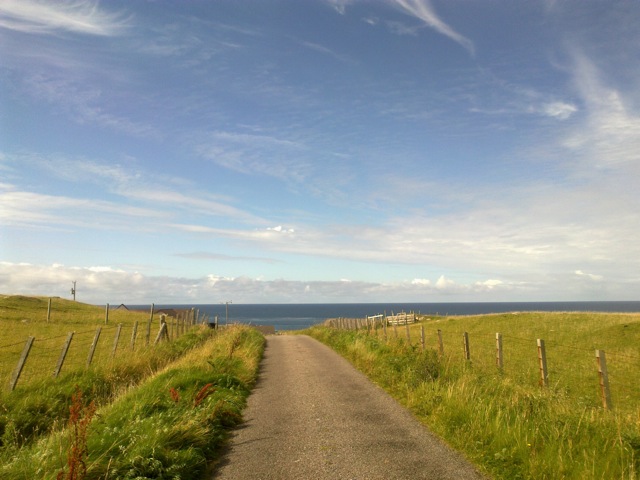
This is where I'm going -- not EXACTLY where (or maybe exactly where). As I said in my last post, I only have a general idea.....and since then that idea has expanded a little to include The Western Isles, where this picture was taken and not by me.

But it's how I feel right now -- I really don't know what this trip will be like, but I'm going.