CBC Diversity


For the past year or so, I've been meeting about once a month with a group of children's book editors from other houses. Founded by Nancy Mercado of Roaring Brook, we called ourselves DIBS (Diversity in Books), and we were hoping to help increase the diversity within the publishing industry, and also in the authors, illustrators, and books published. We started getting a website together and grand plans of doing school visits, job fairs, conferences, and more. But, of course, we were all so busy with our jobs and lives that it was hard to get things going. Well, a conversation at a Children's Book Council cocktail party brought these two groups together, and the CBC Diversity Committee was formed. We had a small kick-off party last week for agents, media, and publishing folks, and we talked about our mission, the importance of it, and what everyone there could do to become a CBC Diversity Partner. Here's a picture of me speaking:
I talked about not being able to fully see myself in the books I was reading as a child.

Diversity is a mission I am absolutely passionate about--it's important not only for children to be able to see themselves represented in the books they read, but also important for children to be exposed to other experiences and viewpoints. It increases empathy and tolerance. And as I said at our kick-off, I hope to live in a world where we can have an Asian Harry Potter or a black Bella without anyone even blinking an eye. We'll get there, I know it!

Please, won't you all join us? I linked above to our mission and how we can all help, and we'll be keeping the CBC Diversity blog active with at least two posts each week. I'm posting this week, so stay tuned!
SUPERBOWL. In the United States more women are battered on the day of the American football championship than on any other day of the year. This should not be taken as a characteristic of football itself...The aim in football is to move the pigskin across the goal line. This positive skill is unfortunately little more than the exotic spice of the game. The central characteristic, involving the football is halted in each play by a physical assault on its carrier. Spectators may well get excited about these repeated demonstrations of basic masculinity. The more excited they become through passive participation, the more their own active manhood may be put into doubt. In the final analysis, a guy's got to prove his own worth by hitting someone himself. Or it may simply be that American women are unbearably slow fetchers of beer.
- John Raulton Saul / "The Doubter's Companion"


Randomly picked this book from the library of Ross and Jennifer, while sitting directly in front of the big screen broadcasting the Super Bowl. Freaky.

from the BRG archives: QUESTION OF THE WEEK: What outside influences do you use to keep yourselves focused ?


Our question of the week is:What outside influences do you use to keep yourselves focused?

ALVINA:
What outside influences do you use to keep yourselves focused?

This is a somewhat ambiguous question--so many ways to answer it! When it comes to my job, it's all about people. I'm influenced by my coworkers and wanting to be good to work with and do a good job; by the authors and illustrators I work with, not wanting to let them down; I'm influenced by the librarians, teachers, parents, booksellers, and others who will read the books I work on; I'm influenced by the knowledge of the reader I am and the memory of the reader I once was as I child; and lastly I'm especially influenced by the child reader that I'm trying to reach, what I think they will love.
I also do have some inspirational quotations up in my office to help me keep things in perspective. One is "Follow your compass, not your clock" which is something I heard at a talk given by Andrea Jung, CEO of Avon. Someone had said this to her when she was trying to make a big career decision amd was conflicted, and I love to think about it when I get frustrated with work, or start thinking that I should be at a higher level, etc. I think, my clock might be saying I'm ready for something else, but my compass is telling me what is most important.

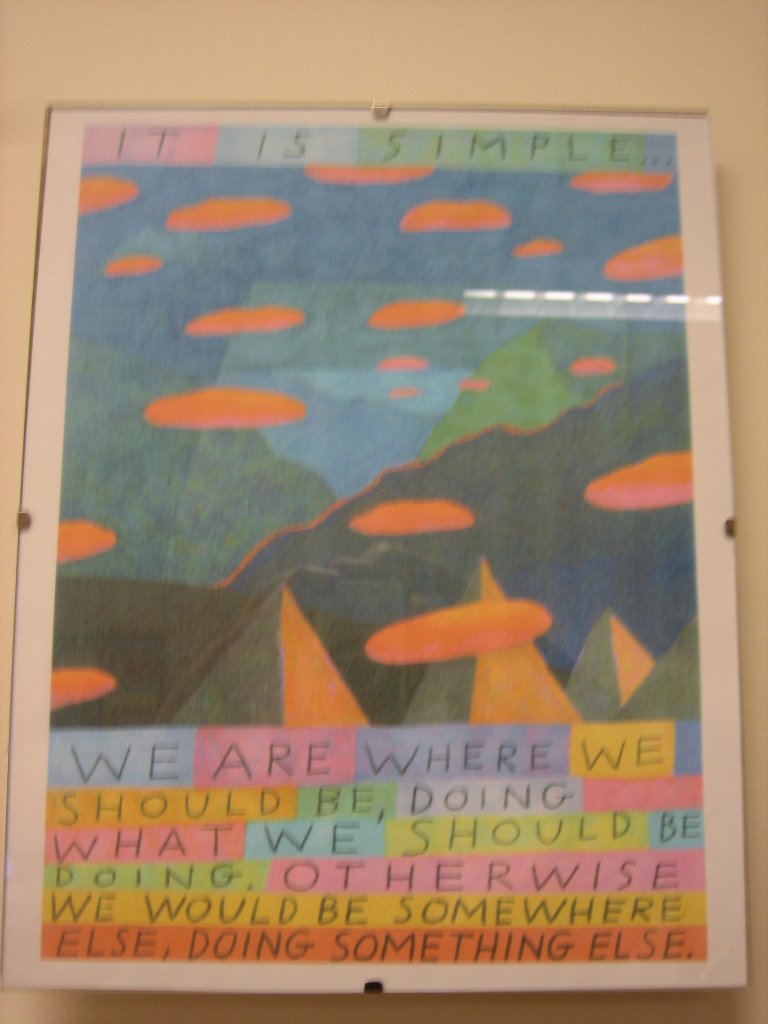
Another quotations is one I commented on in Grace's "Hope and Beauty" post above. "It is Simple. We are where we should be, doing what we should be doing, otherwise we would be somewhere else, doing something else."

And one last quote is from college. I think my roommate Grace (a different Grace!) penned it when we were stressing about midterms or finals. "Feel a sense of inner peace. Do your best. It's never too late!"


ANNA:
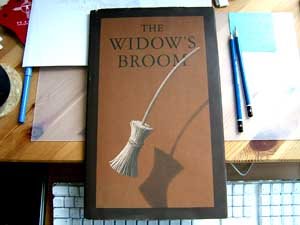
One thing that always brings me back to focusing is looking at work that inspires me, and reminds me why I wanted to make books in the first place. This is one of my all time favorite books. It awes me on so many levels. The quiet, perfect pacing, the understated storytelling, the somewhat unresolved, haunting ending.

This book brings me back to my desk for other reasons as well- my older sister gave it to me as a birthday present when I was applying to college. Chris Van Allsburg taught at RISD, and this was one of the deciding factors in my decision to go there to study illustration. So I guess this book also reminds me of all the hope and excitement I felt taking my first real step towards being an illustrator.

GRACE:
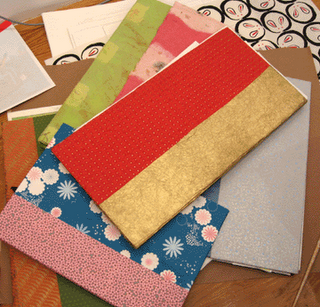
Well, I like to write when things are completely quiet with no distractions; I do have a music mix on my ipod I listen to when I paint.

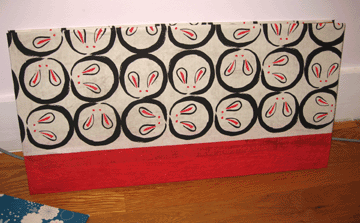
But the one thing I’ve always done is make a folder for my work (I posted a photo of a couple of them to the left). I have a penchant for beautiful paper, making folder portfolios gives me an excuse to buy and use it (though I have a lot more paper than my folders need!). Usually I make the folder at the start of a project—as an incentive to fill it! The folder is a visual reminder for me to keep focused.

Here is my most recent folder made for the art of Lissy's Friends! I just had to post it because I love that bunny paper.


LINDA:
Definitely other people's art. I can get really inspired by a landscape, most especially skies and clouds, but often I end up feeling overwhelmed with the idea of trying to capture glorious reality. Seeing what choices other artists have made to come to their own conclusions of beauty is what gets me motivated to try my own version. I've been most certainly overwhelmed with the prospect of painting the landscapes of northern Tibet for my next book, until I found Nicholas Roerich's paintings of the same thing. His simplified paintings burst with colour, vastness, and desolation. Now I'm itching to get painting again.

Also, music. I could not work without music. Before I paint, I turn it up, I dance like crazy, I spin a baton, I get energy moving in my studio and my body, and then I sit down, and funnel it into my hands. (Did I just admit that in public?)

First published August 27th, 2006

Occupy Writers


More than 3,000 writers have signed their support for Occupy Wall Street and the Occupy Movement around the world. You’ll find their names listed alphabetically at the Occupy Writers website. Some of the writers have submitted “Occupy Writings.” I’m posting excerpts from the Occupy Writings of two authors—Daniel Handler, aka Lemony Snicket, and Alice Walker.
The World We Want Is Us
By Alice Walker

It moves my heart to see your awakened faces;

the look of “aha!”

shining, finally, in

so many

wide open eyes.

Yes, we are the 99%

all of us

refusing to forget

each other

no matter, in our hunger, what crumbs

are dropped by

the 1%.


Click here to read the rest of The World We Want Is in Us and Walker’s other poem the joyful news of your arrest.

**********

Thirteen Observations made by Lemony Snicket while watching Occupy Wall Street from a Discreet Distance
6. Nobody wants to fall into a safety net, because it means the structure in which they’ve been living is in a state of collapse and they have no choice but to tumble downwards. However, it beats the alternative.
9. People gathering in the streets feeling wronged tend to be loud, as it is difficult to make oneself heard on the other side of an impressive edifice.

10. It is not always the job of people shouting outside impressive buildings to solve problems. It is often the job of the people inside, who have paper, pens, desks, and an impressive view.

11. Historically, a story about people inside impressive buildings ignoring or even taunting people standing outside shouting at them turns out to be a story with an unhappy ending.

12. If you have a large crowd shouting outside your building, there might not be room for a safety net if you’re the one tumbling down when it collapses.

13. 99 percent is a very large percentage. For instance, easily 99 percent of people want a roof over their heads, food on their tables, and the occasional slice of cake for dessert. Surely an arrangement can be made with that niggling 1 percent who disagree.

You can read the rest of Lemony Snicket's Thirteen Observations here.

(Note: There's information about how one can join Occupy Writers at their website.)

 ***************

At Wild Rose Reader, I have an original poem about the Petrified Forest titled Fossil Forest.
Karissa has the Poetry Friday Roundup at The Iris Chronicles.


Scourge or Savior? Varying Perspectives on the "Social Golfer"

The message finally seems to be resonating throughout the golf business world: for this industry to be sustainable it's going to need to embrace some changes.

A decade of decline in participation, which ironically coincided with a period of overheated development, has left many who make their living in golf, in a precarious position.  A position that doesn't allow for an exclusionary image... or even the perception of one.

From the PGA of America's recently unveiled Golf 2.0 to the USGA's "Tee it Forward" initiative, to the ongoing efforts The First Tee there's a fresh emphasis on increased accessibility and openness ...on making the game less intimidating and more friendly, fun, affordable. The theory is that all those good things will make a wider swath of the population want to take up the game... and stick with it. Women, families and young people... under-represented among today's golf population... are being courted with particular zeal, as they clearly represent the best hope for growth.

However, while strategic plans reflect this change in direction, and industry stakeholders appear to have collectively embraced it,  I'm not sure everyone's being completely honest with themselves when it comes to welcoming a new... and different... attitude to the golf course.


This thought came to me while reading a recent article by inspiring LPGA player, Judy Rankin.  In Breaking With Tradition, the Hall of Fame golfer writes about the often subtle, country club "traditions" that continue to make the game less-than-welcoming, ...and suggests some smart, out-of-the-box actions to address the twin issues of time and difficulty, so often cited as barriers.

The 26 time LPGA Tour winner is clearly an advocate for upping the openness and accessibility of golf, none-the-less, towards the end of her article there were a couple of paragraphs that made me wonder if avid, competitive golfers are really ready to welcome the "social golfer".

What can women do to help promote change? For starters, we can approach golf more like a sport and less like a social event. A round of golf, although friendly, should not be a chat session. You wouldn't take a break from your serve in tennis to talk for a minute. Women are faster than the general perception, but some could still play faster.


Female golfers also need to step it up on the equipment side. Good equipment is crucial to better play for slower swing speeds. Women should get informed about what's new, and those who can afford it should experiment. Technology levels the playing field, and we need to invest in the game that now really wants to invest in us.

Now here's the thing, I know quite a few golfers (including ...at times ...myself) who play purely for fun.  They rarely keep score and aren't particularly concerned with setting or achieving goals.  This may be due to lack of time or they may just not be competitive by nature.  These folks enjoy "the game", "the social event" and "the outdoor experience" in equal parts, and they generally play with used balls and equipment that's slightly, um, "retro",  but... they're as well-versed in golf etiquette as the most avid competitive golfers, thus pace-of-play is never a problem with them. In fact, they often find themselves slowed down by the more "competitive, goal-oriented types" who A. search endlessly for their expensive lost balls B. mark every single putt C. spend excessive time reading greens D. obsessively wash their balls and replace their club covers.

Don't get me wrong, I see where Judy Rankin is coming from and agree that players... male or female... who don't adhere fully to the rules of golf etiquette and pace-of-play are an anathema to the game.  What concerns me though, is that in the midst of this unprecedented industry-wide effort to grow the game and keep players in it, there may still be a substantial block of "avid golfers" who aren't quite ready to set out the welcome mat for anyone they consider a "social golfer".  In fact, there's already ample evidence of this on the golf message boards.

The fact is, "Social Golfers" will need to be a key part of any strategy that aspires to drive new players to the game and even more so when the goal involves re-engaging lapsed players.  What this makes clear to me is that the programs being put into place to grow the game must include new and innovative approaches to communicating, teaching and reinforcing golf etiquette.  More than anything else this may eventually lead to a warmer welcome for new players and a more positive  perspective on "Social Golfers".

B&N vs Amazon


As a follow up to this post, this article explains what B&N is doing in response to Amazon's business tactics (essentially refusing to carry any books published under Amazon's imprint). In a way it seems only fair; if Amazon is going to try to undermine brick and mortar book stores, doesn't it make sense that they fight back? What do you think?

Interpreting editorial letters


As an author, I get editorial letters; as an editor, I write them.
How do you handle them when you're the author? How do you want the author to handle them if you're the editor?

As the author, I usually ask for clarification if I don't understand something. If an editor suggests a change, I feel that I have to do something -- that I can't just leave whatever it was as it is. But even if the editor has made a suggestion, I usually feel that I can solve the problem my own way. If I really like the editor's solution, I'll use it; if I don't, I'll think of my own. I always do something.

But I've heard of authors who just leave things as they are!

As an editor, do you think the author has to fix what you've commented on, or is that optional? And what about how the author fixes it? Are you annoyed if she doesn't do what you suggest, but solves the problem her own way? And what would you do if an author (this happens to me as an editor sometimes) interpreted everything you said as praise and didn't want to change anything?

Not to be sexist, but this does happen to me more with male authors: I'll send a letter saying what I liked, and then suggesting changes, and the author responds,

"Oh, you liked it! Great!"

When I'm the editor, I'm in a different situation from most people reading these pages, I think -- I'm being paid by the author to get the ms. into publishable condition. So what I do in that case ("that case" being when I've sent a long letter and the author responds only to the praise) is get blunter -- painfully blunt, sometimes.

So you'd think I'd be good at reading editorial letters, but not always! When I'm the author, letters from an editor I don't know can be really hard to interpret, and I've gotten it wrong more than once. So, anything anyone has to say would be helpful....

Lastly, I'm talking here about books that are under contract. Alvina's post (was it called Rejection Letters 101) on submissions was hugely helpful. It's easy to misinterpret those letters, too.